The history of Mount Athos is a living continuum, where myth, faith, and daily life merge. The mountain has been inhabited by hermits and monks for more than a thousand years, yet its story begins in legend — with giants, gods, and the Virgin Mary herself.
Origins and Myth
The first hermits arrived in the 3rd and 4th centuries, carving out lives of prayer and silence in caves and huts. Pirate raids drove them further inland, into the mountain’s protective forests and ravines. By the 9th century, imperial decrees recognized their presence and granted land, laying the foundation of a monastic state.
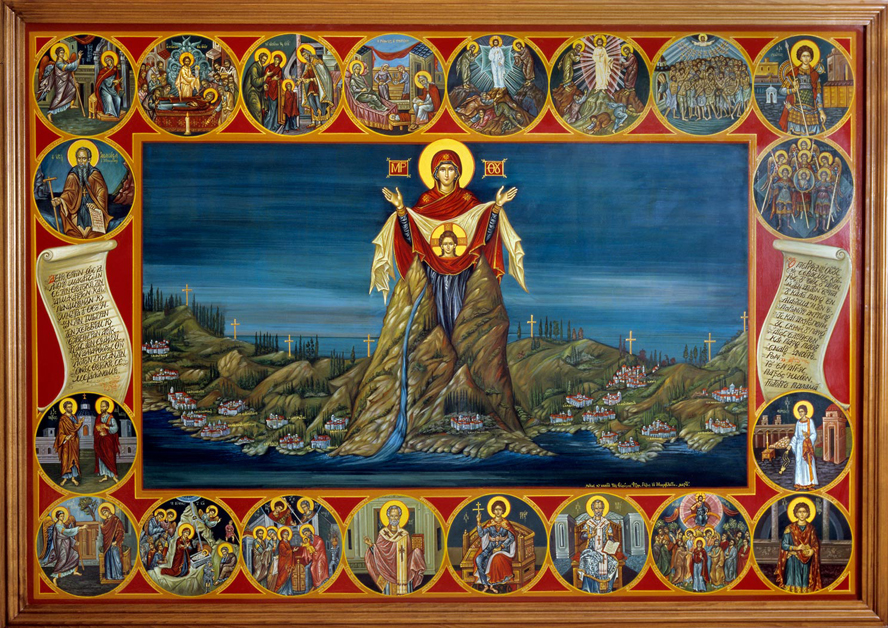
According to Greek mythology, the giant Athos hurled a rock at Poseidon during the battle of the gods, and the stone became the mountain that now bears his name. Another tale says that Poseidon buried the fallen giant beneath the massif. In Christian tradition, the Virgin Mary, sailing with John toward Cyprus, was driven by storm to the Athonite shore.
Enchanted by its beauty, she asked her Son to give her the place as an inheritance. A voice answered: “Let this be your garden and haven of salvation.” Since then, Athos has been known as the Garden of the Virgin Mary, sealed by the rule of Avaton, which forbids the entry of women.
The Byzantine Flourishing
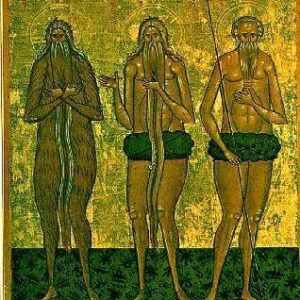
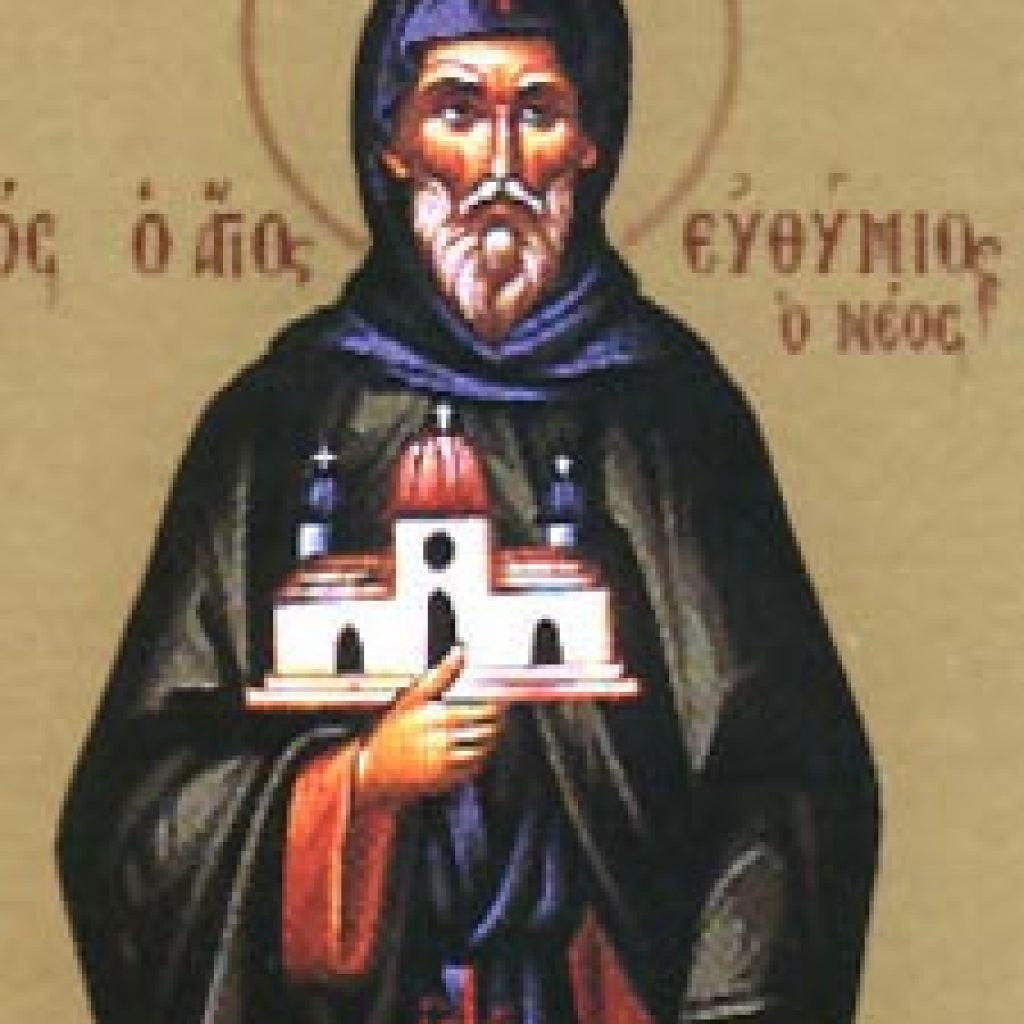
Two early figures embody Athos’ dual spirit: Peter the Athonite, exemplar of the solitary hermit, and Euthymios of Thessaloniki, who introduced communal life. This progression from eremitic to communal and finally to cenobitic life gave Athos its lasting structure.
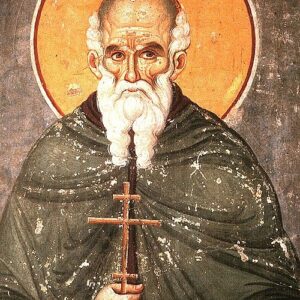
The great turning point came in 963, when St. Athanasios the Athonite, supported by Emperor Nikephoros Phokas, founded the Great Lavra. Unlike scattered huts, it was an organized brotherhood, combining prayer, work, and learning. Athanasios soon drafted the Typikon of 972 — the first charter of Athos, known as the Tragos. It established internal governance, regulated property and daily life, and even included rules on wine commerce, insisting it be used in moderation and never for profit
Peter the Athonite
Euthymios of Thessaloniki
St. Athanasios the Athonite
Trials and Resilience
The golden age was not without shadows. In 1204, Latin Crusaders tortured monks and burned monasteries. In the 14th century, Catalan mercenaries repeated the devastation. Yet under the Palaiologos dynasty, Athos rose again, replenished with gifts from Slavic princes and emperors.
With the Ottoman conquest, Athos sought survival through accommodation. In the 15th century, monks swore loyalty to Sultan Murad II, who confirmed their privileges. Prosperity continued into the 16th century, but heavy taxation later drained resources, leading to decline and near abandonment.
A brighter moment came in 1749, when the Athoniada Academy opened at Vatopedi, becoming a center of Greek learning under the scholar Eugenios Voulgaris. It symbolized Athos’ enduring role as not only a monastic but also an intellectual powerhouse.
Revolution and Recognition
During the Greek War of Independence in 1821, Athos provided refuge to families and supplied fighters with food and money. When the revolt was crushed, many monks and civilians were massacred, monasteries were plundered, and treasures lost. Recovery was slow but steady.
In 1878, the Treaty of Berlin recognized the autonomy of Athos. In 1912, during the First Balkan War, it was liberated by the Hellenic navy. The Greek state ratified the Constitutional Charter of Mount Athos in 1926–27, ensuring constitutional protection of its unique self-governance.
The Twentieth Century and Beyond
Athos endured the upheavals of the 20th century. During WWII, monks hid relics and sheltered resistance fighters; when German troops arrived, the Holy Community appealed for protection. Though investigations and looting attempts occurred, Athos emerged with its heritage largely intact.
By the 1960s, decline threatened, with dwindling numbers and ruined buildings. Yet renewal followed: new generations of monks arrived, monasteries were restored, and ancient traditions were revived. In 1988, UNESCO recognized Mount Athos as a World Heritage Site, describing it as “a vast repository of historical, artistic, and cultural heritage preserved by a monastic community for twelve centuries.”
Now,
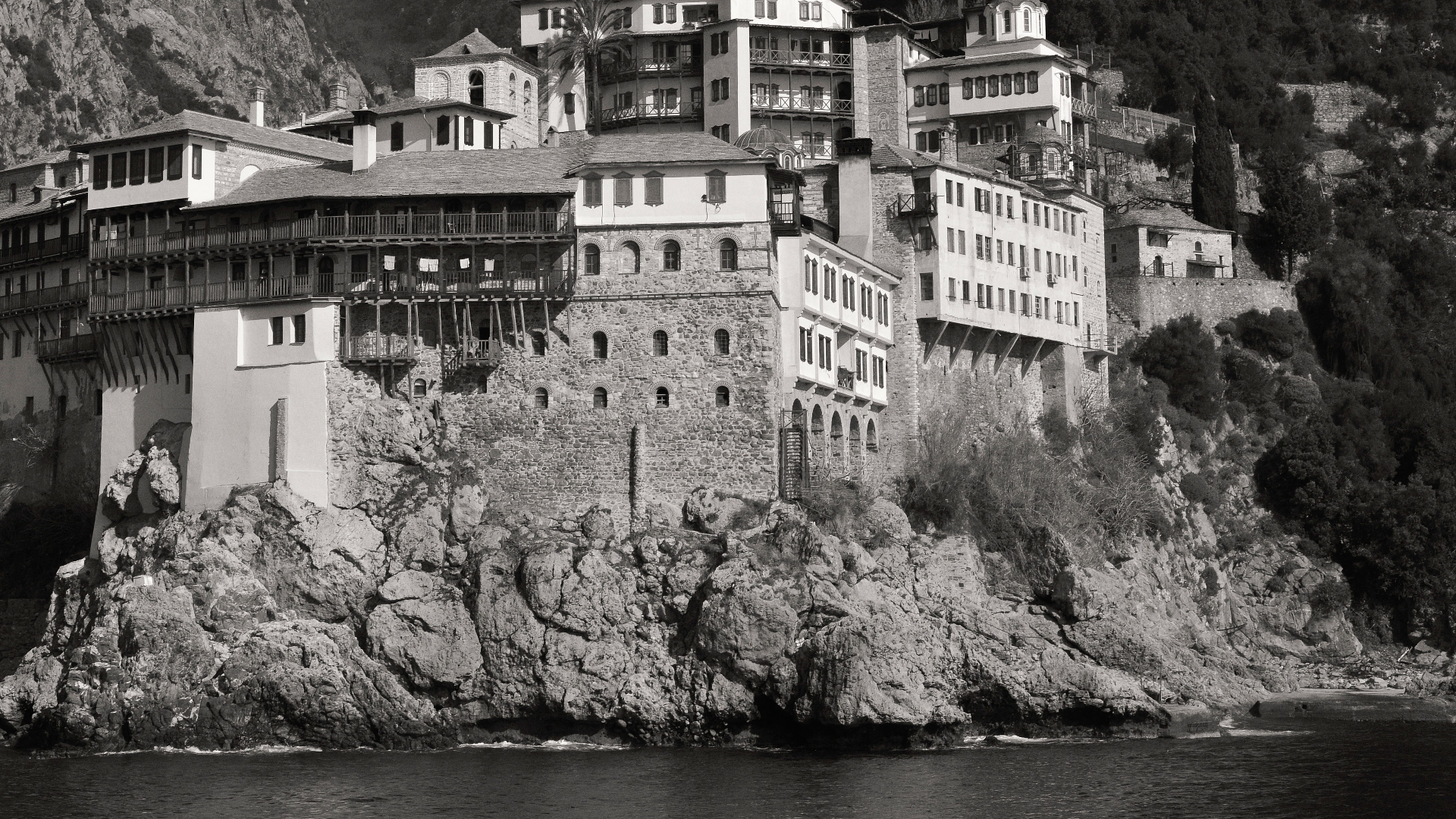
Mount Athos today consists of 20 monasteries, 12 sketes, and around 700 cells, inhabited by some 1,800 monks. Access remains limited, governed by the Diamonitirion permit. The rhythms of prayer and labor continue, just as they did a thousand years ago.
Its history is not a museum of ruins, but a living continuity: a place where myth became tradition, where empires rose and fell, and where monks still rise before dawn to pray, to work the land, and to safeguard a sacred inheritance.
Shopping Basket
English (UK)
English (UK)
Français
Ελληνικά
English (UK)
English (UK)
Français
Ελληνικά
LIFE & TRADITION
Lorem ipsum dolor sit amet, consectetur adipiscing elit. Ut elit tellus
Monastic Life
History
Typikon
LAND & TERROIR
Lorem ipsum dolor sit amet, consectetur adipiscing elit. Ut elit tellus
Terroir-zones
Soils & Microclimates
Nature & Sustainability
Natura & Biodiversity
VINEYARDS & WINEMAKING
Lorem ipsum dolor sit amet, consectetur adipiscing elit. Ut elit tellus
Grapes
Viticulture
Winemaking
Glossary
PGI & IDENTITY
Lorem ipsum dolor sit amet, consectetur adipiscing elit. Ut elit tellus