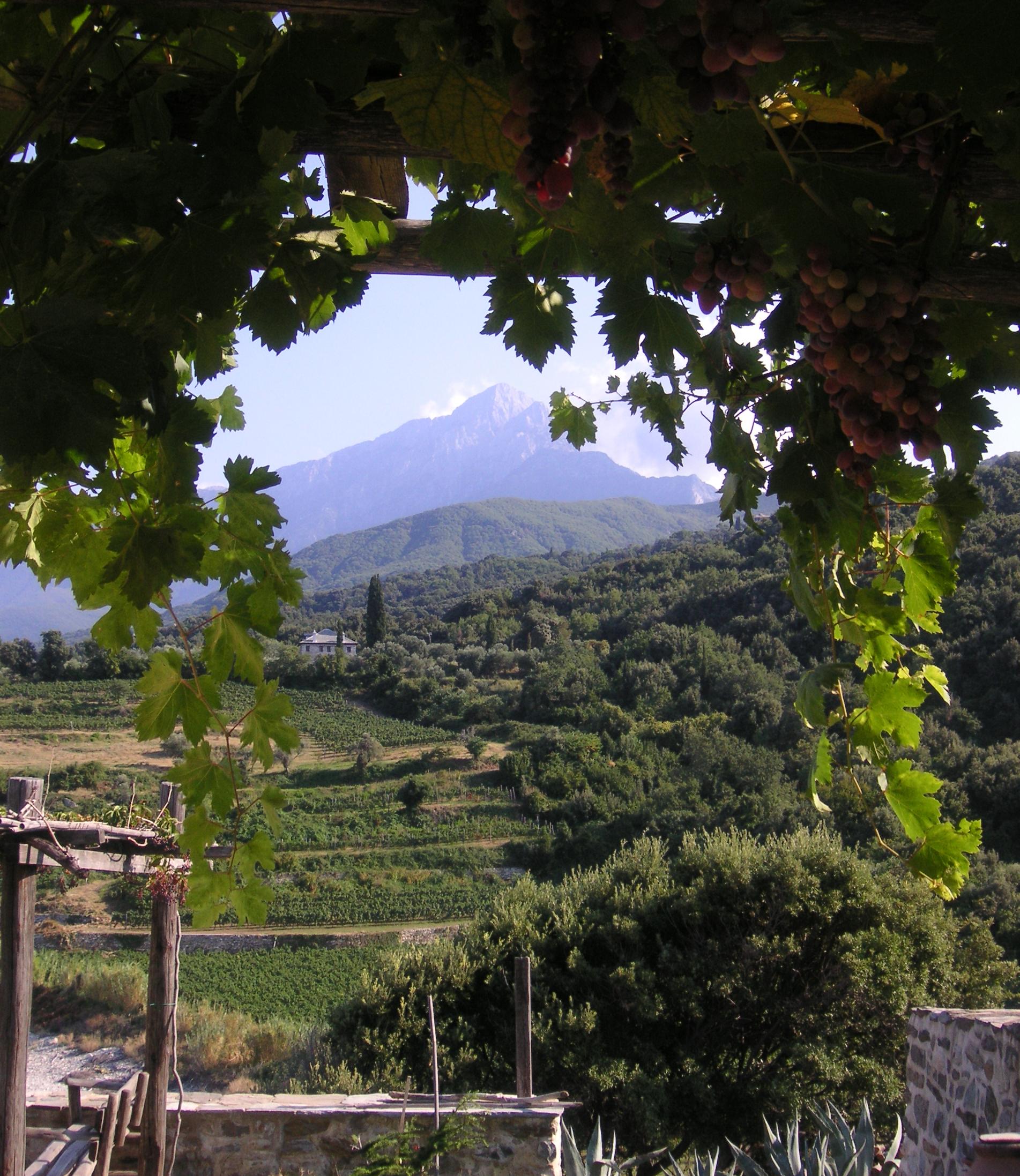
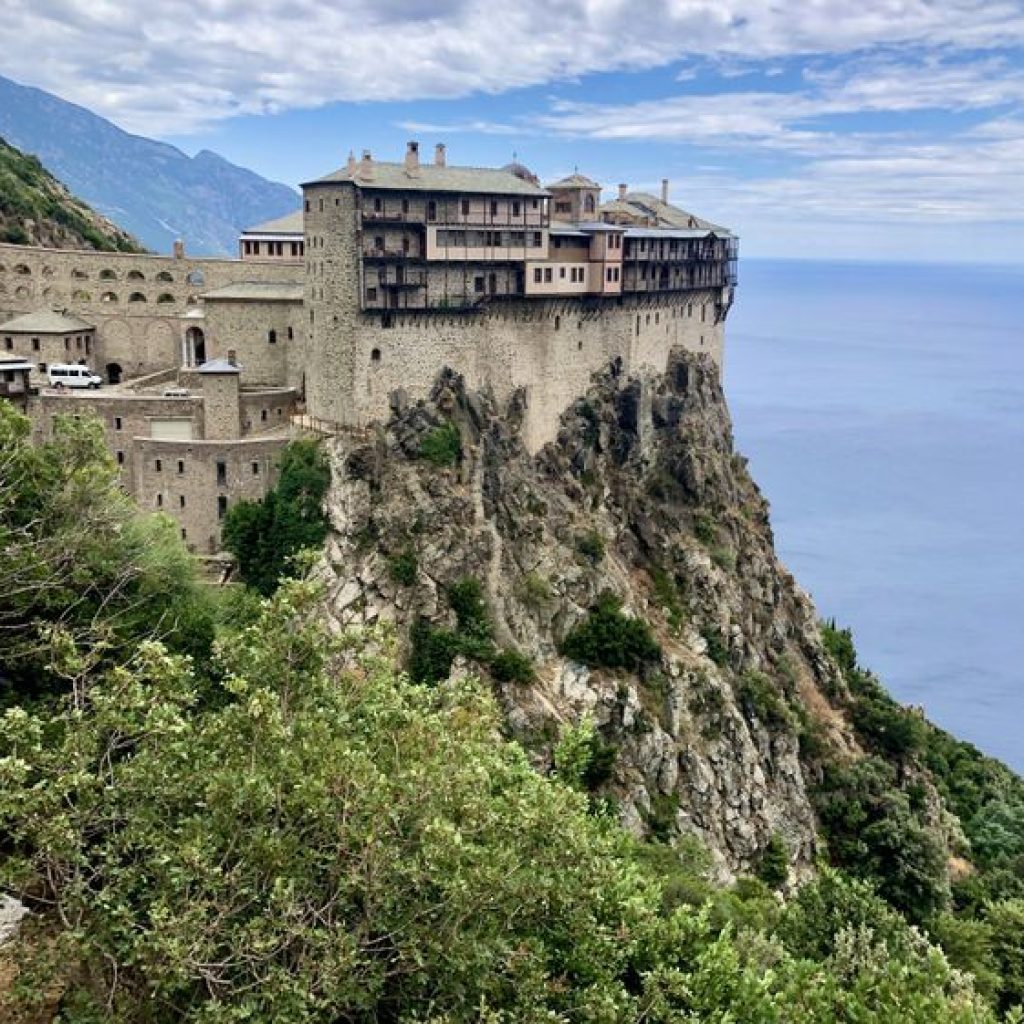
The vineyards of Mount Athos thrive in a landscape where sea, mountain, and forest meet within just a few kilometers. Although the area is small, the diversity of exposures, altitudes, and soils creates a remarkable variety of growing conditions. From plots close to the Aegean coast, cooled by maritime breezes, to hillside terraces shaped by forest air and alpine currents, each zone gives the vines a different character.
Terroir and Microclimates
The peninsula’s position creates a patchwork of terroirs in a relatively small area.
✣ Coastal vineyards benefit from cooling breezes, higher humidity, and moderated summer heat.
✣ Mid-altitude vineyards experience sharper diurnal shifts, with cooler nights that preserve freshness and acidity.
✣ Mountain-adjacent parcels are influenced by alpine air currents, producing slower ripening and greater aromatic complexity.
Vineyard altitudes generally fall between 200–300 meters above sea level, though the peninsula itself rises to 2,033 meters at its peak. This range allows for varied sun exposure and a diversity of grape expression even within a single monastery’s holdings.
Climate Profile
The Athonite climate belongs to a transitional Mediterranean zone, moving from maritime conditions at the coast to more continental, humid climates in the interior:
✣ Summers: Warm but moderated, with average highs of 31 °C in July–August.
✣ Winters: Mild, with January–February averages around 8 °C and nighttime temperatures rarely dropping below 0 °C.
✣ Rainfall: 470 mm annually in low areas, rising to 850 mm in higher zones, concentrated from October to April.
✣ Winds: Predominantly from the north and northeast, with southerly breezes more common in summer, aiding vineyard ventilation and reducing disease pressure.
This climate profile ensures steady ripening without extremes of frost or heat stress — a rarity in northern Greece, thanks to the moderating effect of the Aegean.
Geology & Soils
Geologically, Mount Athos continues the Rhodope massif, marked by metamorphic and crystalline formations:
✣ Soils: Typically sandy loam and sandy clay with granite subsoil, well-drained and poor in nutrients.
Such mineral-rich but restrained soils naturally limit yields, concentrating flavor and imparting the signature minerality of Athonite wines.
ChatGPT said:
What makes the terroir truly unique is not only its natural diversity but also the spiritual stewardship with which it is cultivated. The vineyards are embraced by dense forests of chestnut, conifer, and other Mediterranean flora, forming a protective and balanced ecosystem that nurtures both the vines and the surrounding landscape.
Shopping Basket
English (UK)
English (UK)
Français
Ελληνικά
English (UK)
English (UK)
Français
Ελληνικά
LIFE & TRADITION
Lorem ipsum dolor sit amet, consectetur adipiscing elit. Ut elit tellus
Monastic Life
History
Typikon
LAND & TERROIR
Lorem ipsum dolor sit amet, consectetur adipiscing elit. Ut elit tellus
Terroir-zones
Soils & Microclimates
Nature & Sustainability
Natura & Biodiversity
VINEYARDS & WINEMAKING
Lorem ipsum dolor sit amet, consectetur adipiscing elit. Ut elit tellus
Grapes
Viticulture
Winemaking
Glossary
PGI & IDENTITY
Lorem ipsum dolor sit amet, consectetur adipiscing elit. Ut elit tellus