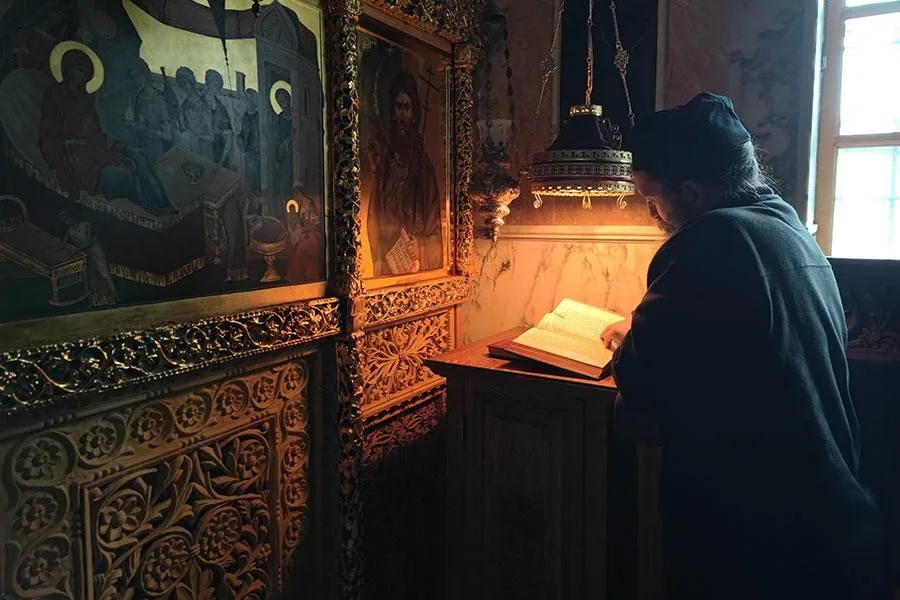
 01 · Prayer
01
The root
Prayer
Prayer structures the monastic day and provides the shared framework within which worship, meals and assigned work take place.
Attention · silence · devotion Mount Athos Wines
 Wines ofMount Athos
Search the archive

Prayer · work · hospitality
Daily life ordered by prayer, work, hospitality and a profound respect for the land.
Begin the story ↓Wine as ritual, nourishment, and heritage
Wine has liturgical, dietary, hospitable and economic roles in Athonite history. Today, wine intended for the Divine Liturgy must be distinguished from table wine and from commercially available PGI wine.
Monastic sources place agricultural work within a religious discipline of prayer and communal responsibility. Production scale, equipment and vineyard practice nevertheless differ among monasteries, dependencies and producers.
A life of prayer and work
Prayer, cultivation and hospitality are not separate activities. Select a stage to see how each belongs to one continuous practice.
01 · PrayerThe root
Prayer structures the monastic day and provides the shared framework within which worship, meals and assigned work take place.
Attention · silence · devotionPrayer and work
In cenobitic monasteries, worship, meals and assigned work are organised communally. Vineyard tasks also follow the biological cycle of the vine and the practical demands of each growing season; they should not be presented as if fixed directly by the liturgical calendar.
Agricultural work can be understood within the monastic vocation of obedience, service and care for the community. This is a religious interpretation of work, not a technical description of viticultural method.
On Mount Athos, the vineyard belongs simultaneously to a working agricultural landscape and to a monastic cultural landscape. Its spiritual meaning does not remove the need for precise, producer-specific information about cultivation and wine production.
Spiritual ecology
Tradition holds that the Virgin Mary blessed Mount Athos as her inheritance, which is why it is often called the “Garden of the Virgin Mary.” This belief shapes the monastic relationship with the land. Native herbs, wildflowers, forests and vineyards coexist within a diverse landscape; agricultural methods and environmental certifications must be stated for each producer rather than generalised across the entire peninsula.
This tradition offers an important ethical framework for care of the land. Environmental performance, however, must be evaluated through documented practice and, where claimed, recognised certification.
Explore the living ecosystem →Continuity and adaptation
Wine in monastic life
Wine is used in the Divine Liturgy and can also accompany communal meals. These are distinct uses. The fifteenth provision of the first Typikon of 972 also addressed wine sales beyond the boundary at Zygos.
Written records, monastic installations and the PGI specification attest to a long history of viticulture and winemaking, although production has changed in scale and technology over time.
Manual labour remains important in many Athonite vineyards. It is not scientifically accurate to describe every vineyard as entirely hand-cultivated; methods and equipment vary by producer.
Viticulture remains part of the relationship between monastic communities, land and hospitality, while contemporary PGI production also operates within a regulated commercial framework.
The two wines: Nama and the table
Divine Liturgy
Wine selected or prepared for use in the Divine Liturgy according to ecclesiastical requirements; it is distinct from table wine.
Liturgical · ecclesiastical useCommunity & visitors
Wine served with communal meals is distinct from liturgical wine; commercially available table wines may also be distributed beyond the peninsula.
Meals · hospitality · public wineOn Mount Athos, wine used for the Divine Liturgy must be distinguished from table wine. The former is governed by ecclesiastical requirements; table wine accompanies communal meals and may also reach the wider public. This presentation principally concerns table wine and PGI production.
The annual vineyard cycle
Pruning, shoot growth, canopy management and harvest follow the vine’s biological cycle and local weather. In a monastery, this agricultural calendar unfolds alongside the liturgical life of the community.
Rest · pruning · preparation
Renewal · growth · tending
Canopy · vigilance · patience
Gathering · gratitude · community
Wine & the monastic table
These pairings concern table wine and the peninsula's food culture—a cultural guide following the rhythm of Lenten (nistísima) and feast-day (giortina) cooking.
Explore table-wine styles →


